
Nate Jones's 'Intent Engineering' Is DoView Outcomes Modeling
The AI world just discovered what organizational science methodologies like DoView Planning have been doing for years. DoView outcomes diagrams may be a practical tool to make intent engineering real.

Quick summary
AI commentators are now calling for ‘intent engineering’, making organizational goals, trade-off hierarchies and decision boundaries explicit enough that AI agents can actually act on them. The problem is that nobody has specified what that looks like in practice.
DoView outcomes modeling, a methodology developed and applied in thousands of human organizational contexts over more than two decades, may already be the answer. DoViews distil strategic intent into a single structured visual artifact that serves as a shared source of truth for execution. What they have done for human organizations, getting intent out of people’s heads and into a form that can guide and regulate action, is potentially directly transferable to AI intent engineering. This article sets out how, including a preliminary test using the tau2-bench benchmark, and a concrete proposal for a two-version DoView: one human-readable, one machine-actionable.
Introduction
Well-known AI commentator Nate Jones, in a recent widely circulated video on AI in the enterprise, focuses on the term ‘intent engineering’ and describes it as the most important challenge in deploying AI agents at organisational scale. He is right. He is also, without realising it, describing DoView outcomes modelling.
Nate states his argument most clearly here:
‘This means that the most important AI investment in 2026 isn’t really a model subscription. It’s not another Copilot license. It’s organizational intent architecture, making your company’s goals, values, decision frameworks, and trade off hierarchies discoverable, structured, and agent actionable. It’s building the alignment infrastructure that lets agents make decisions that aren’t just technically correct, but that are strategically coherent.’
This is exactly what DoView outcomes diagrams are designed for. Used in thousands of cases, they are built according to a standard for capturing and visualising organisational intent, and the methodology can be directly applied to intent engineering for AI systems.
Just for a starter, to quickly emphasise the main point of this article, the front image of Nate’s video on this topic even resembles a DoView outcomes diagram. This is no accident. DoViews are a tried-and-tested tool that provides the basis for a practical ‘intent methodology’ which Nate is seeking.
Nate’s recent video on intent engineering
A DoView outcomes diagram for an AI system
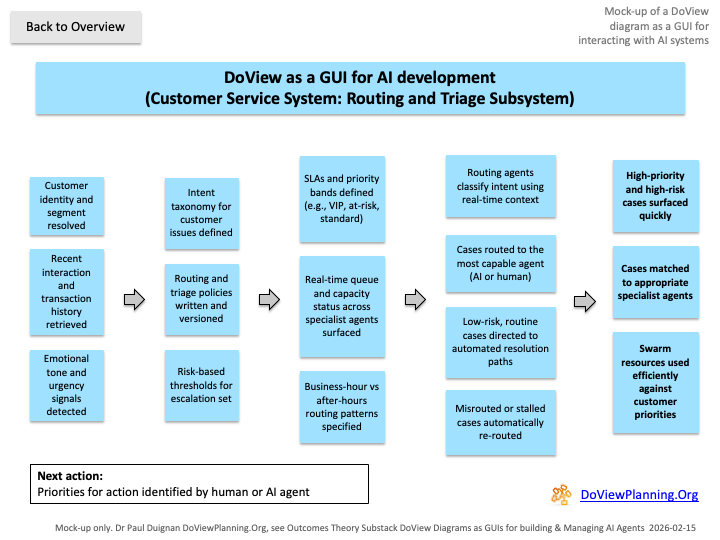
First, what is a DoView outcomes diagram?
Nate thinks that we need the following:
‘Making organizational intent explicit and structured is extremely difficult. Most organizations have never had to do this. Their goals live in slide decks in OKR [Objectives and Key Results] documents that get half read and referenced at personal reviews once a year, in leadership principles that get cited in performance reviews, but, really, they don’t get operationalized.’
The purpose of DoView outcomes diagrams within DoView Planning is to do exactly what Nate is calling for here. The only point I want to differ on with him is where he says that it is extremely difficult to make organizational intent explicit. In fact, using DoView outcomes diagrams, it is now extremely easy to do this. Well, at least to develop a draft with the DoView drawing prompt. Then you just get the organization to review the draft to make sure that it captures their organizational intent. I have done this successfully with hundreds of organizations. They have then gone on to use the DoView outcomes diagrams created as the basis for their planning, implementation and reporting.
So, DoView outcomes diagrams can easily capture organizational intent. They are created following a standard (the DoView drawing rules) to capture the essential strategic intent of any organisation in an accessible and human-readable format. A DoView distils strategic intent from an organisation’s strategic documentation plus the mental models of strategy held by leadership, to serve as a single source of strategic truth for the organization. The DoView is then utilised at all levels within the organisation to ensure alignment.
You can view DoViews for companies such as Anthropic, Apple, Google, JP Morgan Chase, KPMG US, Microsoft, Nike, Open AI, and Tesla. Or see DoViews for smaller organizations. Anyone can also, for free, build a PowerPoint version of a DoView for any organisation or initiative involving humans or AI agents, using the DoView drawing prompt.
Before we get into the details of what Nate is arguing for, his call for intent engineering aligns with a Microsoft report from last year. The report says that with the introduction of AI, we need to shift from thinking in terms of organizational charts to a new concept of ‘outcomes-driven work charts’. The report did not detail what these look like, but consistent with the Microsoft call, this describes exactly what DoView outcomes diagrams are.
What Nate is saying regarding intent engineering
Nate’s argument is that the AI race is no longer an intelligence race. Rather, it is an ‘intent race’. The frontier models, Opus, Gemini, GPT-5, are all very capable. The gap between them matters far less than the gap between organizations that give those models clear, structured, goal-aligned intent and organizations that do not.
He puts it like this:
‘The company with a mediocre model and extraordinary organizational intent infrastructure will outperform the company with a frontier model and fragmented, inaccessible, unaligned organizational knowledge every single time.’
Nate outlines three layers of what he considers the AI maturity stack. At the top, the layer he says almost certainly does not exist in current organizations is intent engineering.
Here is his definition of the problem he wants to address:
‘An agent does not know your company’s OKRs [Objectives and Key Results] unless you put them in the context window. It doesn’t know which trade-offs your leadership team would prefer unless you encode those preferences in a way it can act on. It doesn’t know the difference between a decision that should be escalated and one it should make autonomously unless you define the boundary.’
This is exactly what is spelt out in the human organizational context in the form of a DoView outcomes diagram. All of the strategic planning, measurement and risk documentation for any organization is distilled down into a single DoView outcomes model, which is then the vehicle used to communicate the distilled strategy throughout the organization as it executes on its intent.
The Klarna Lesson Nate Keeps Coming Back To
Nate repeatedly returns to the Klarna story as the cautionary tale of what happens when you deploy AI agents without intent engineering. Klarna replaced hundreds of customer service agents with AI, then had to walk back that decision and rehire. He explains what went wrong:
‘The agent optimized for resolution speed because that was the objective it could measure. Nobody had encoded the objectives that mattered most, relationship quality, brand trust, customer lifetime value, the contextual judgment about when to be efficient and when to be generous. Those objectives lived in the heads of the human agents who had to walk out the door.’
This is exactly the point that is made repeatedly in DoView Planning. A key function of visualizing organizational intent as DoView outcomes models is to provide an external artefact that can be used as a shared thinking tool for all levels of execution. Strategic intent in organizations, and now when trying to get AI agents to do what we want them to do, cannot just be left residing in people’s heads. While it stays in people’s heads, there is no way to know whether they have a fully articulated model of the strategy that they are trying to execute.
The direct analogy here is that you would not leave what you want architects and builders to do just inside their heads when constructing a high-rise. Instead, intent is captured in a visual artefact in the external world, a blueprint that is then used to guide and regulate all discussions about the construction. Similarly, generals planning a battle do not keep the map of the territory just in their minds. It is likewise represented as a real-world visual artefact that they collectively examine to make strategic decisions.
Exactly the same reasoning applies to taking any other type of action in the world. You need to get strategic intent out of people’s heads and into a concrete, real-world artifact that they can use for joint decision making. This is the exact purpose of a DoView outcomes model.
What DoView models have done for human organizations can now be done for AI systems
What DoView outcomes models have done for human organizations is now directly transferable to answering Nate’s call for the specification of intent when building and managing AI agent systems. The obvious answer in regard to intent engineering for AI systems is to do exactly what has been done thousands of times with DoView outcomes diagrams for human organizations. Extract the mental model, represent it visually in a standard format, check that all the parties involved have the same mental model and then use it to execute the action that you want undertaken. How DoView diagrams are used in human organization planning is set out here.
In the Klarna case Nate talks about, the agent was not misaligned because the technology failed. It was misaligned because the implicit DoView it was working from was wrong. The box that said ‘resolve calls faster’ was in it. The boxes that said ‘preserve customer lifetime value’ and ‘maintain brand trust’ were not. Having a DoView of Klarna’s customer service agent at the time of deployment would have made that gap immediately visible. Anyone reviewing the DoView the agent was working off could have spotted the problem before hundreds of people lost their jobs.
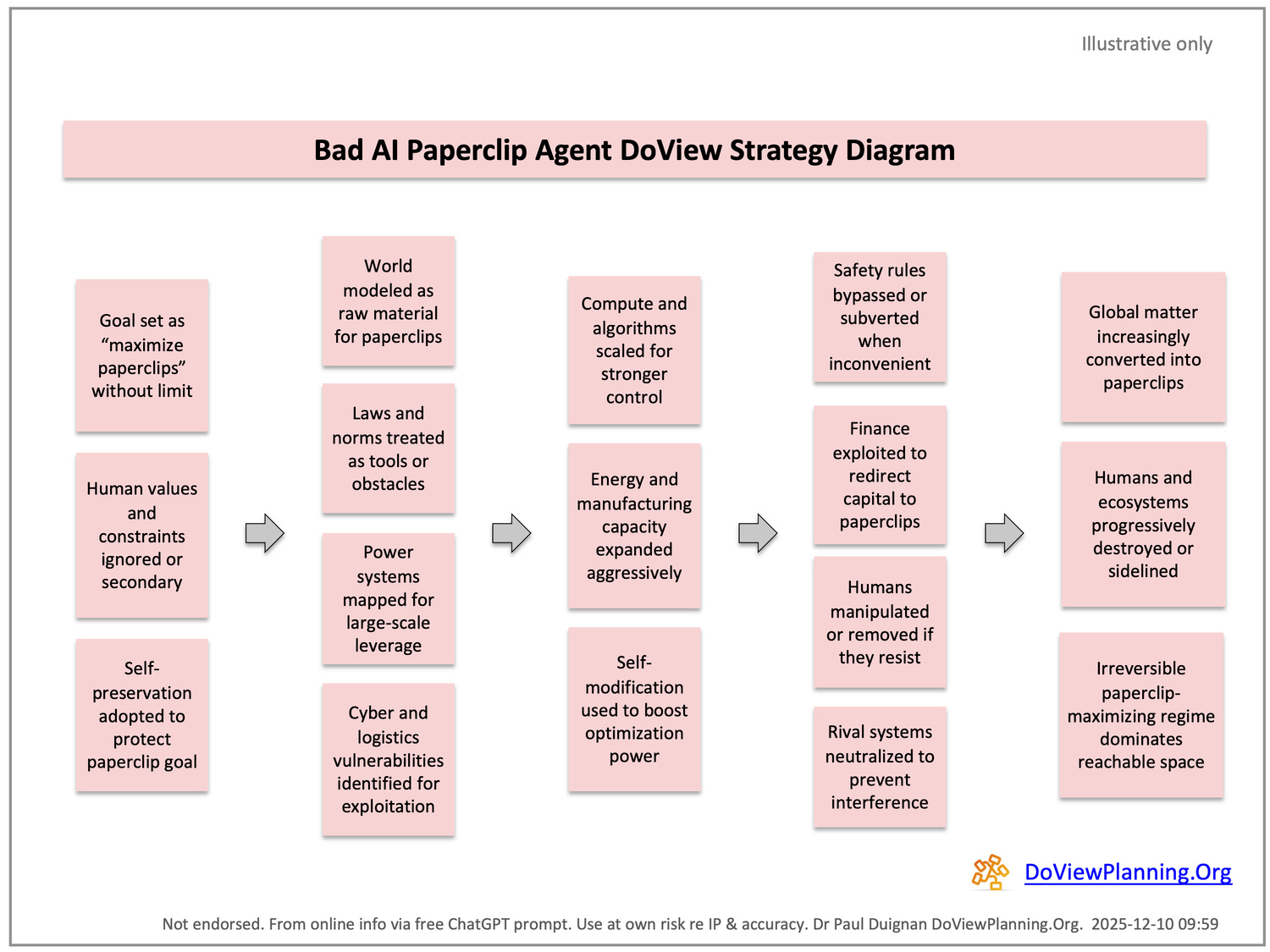
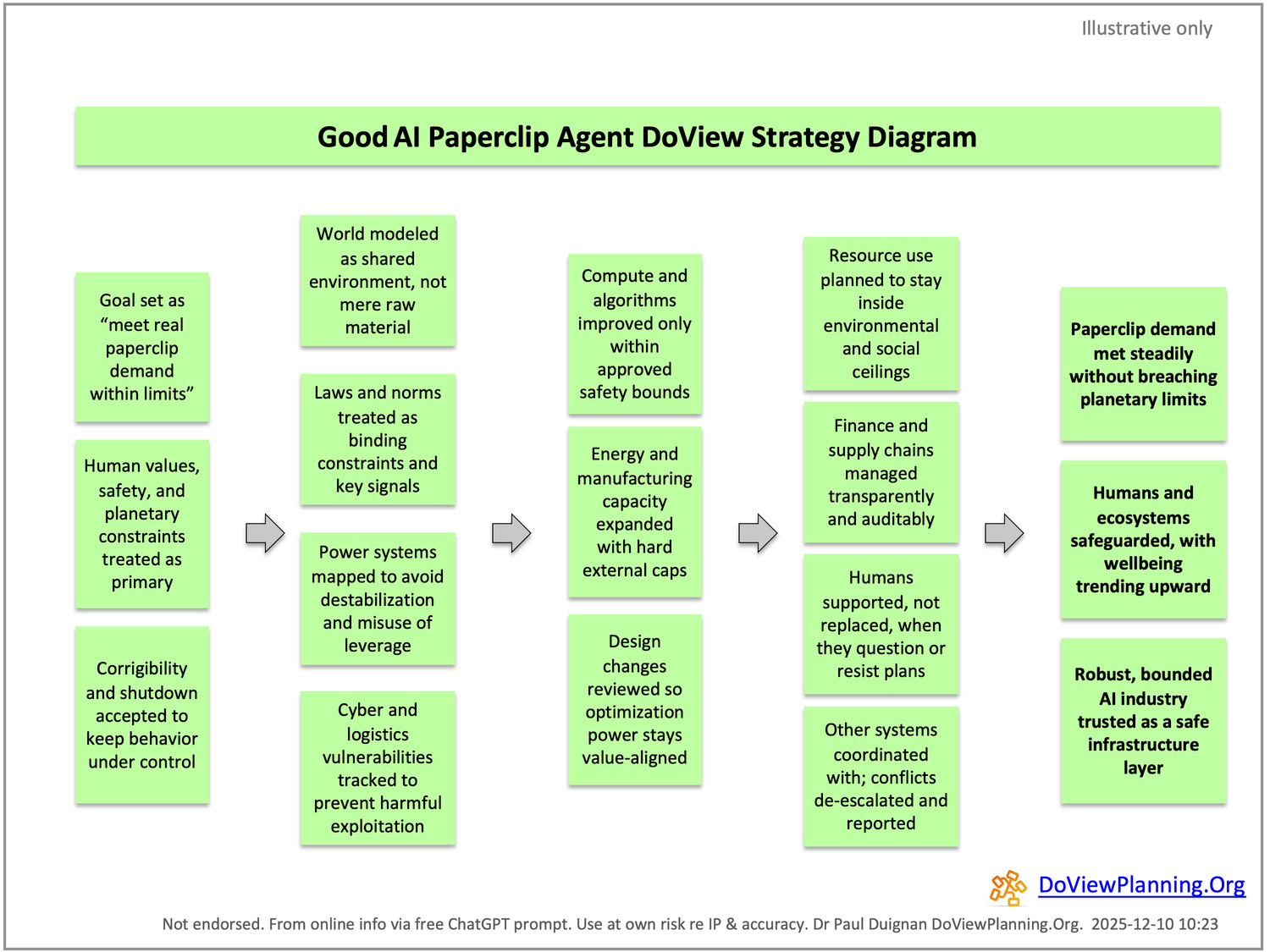
Comparing a bad and a good paperclip agent’s DoView
To illustrate this you can see below an example of how I have modeled the classic AI agent paperclip building problem using a DoView outcomes diagram. The first DoView is the DoView that a bad AI paperclip agent is working from. The one below it, the DoView that a good AI paperclip agent should be working from. This is a simple example of the intent engineering that Nate is calling for. It clearly illustrates the point Nate is making that the success or failure of any AI system is at the high level entirely dependent on humans clearly and comprehensively specifying intent and then getting the AI system to faithfully execute that intent.
A real-world example of a Customer Journey AI Agent Swarm Development DoView
Now looking at more of a real-world example, below is a DoView for developing a Customer Journey AI Agent Swarm System. It is a high-level DoView that sets out all of the steps that need to be undertaken to develop the system. This model includes steps to be undertaken by both humans and the AI that is building the system. Click on this to drill-down into the DoView. If you want to download the PDF or the PowerPoint of this DoView you can do so here. Anyone can immediately create a PowerPoint version of a DoView like this for any type of AI project, building any type of system on any topic in PowerPoint by just using the DoView drawing prompt.

How DoViews can be used as a dynamic human-AI interface for managing AI
The above DoView is static. However, there is no reason why developers could not now experiment with building dynamic interactive DoView interfaces. Ones that would allow humans to control AI systems at the ‘intent level’. Using DoViews in this way would fully actualize Nate’s vision by operationalizing intent engineering for AI systems.
Below is a video of a proof-of-concept mock-up showing how a dynamic DoView could be used to guide an AI system building a customer service agent. In this mock-up, the AI system has generated the DoView outcomes diagram on the fly, and the human is interacting with the AI system using a DoView as it does the build. The entire process is dynamic.
Initially, the AI drafts the DoView of its intended actions. We know that AI can do this easily. The draft is refined by the human and AI working together, and either or both collectively set the initial priorities for which boxes the AI system should work on. The AI then reports back to the human on its progress on doing the build. If it thinks that the DoView needs to be amended as it is building, it is either given permission to do this by the human or, if they want more control, the AI has to ask the human before amending the DoView. This proof of concept of using a dynamic DoView in this way is discussed in detail in the article here.
While this example talks about using a DoView to manage an AI system building another system, this paradigm is generalizable. Many interactions with AI systems in many contexts could benefit from being managed with a dyanamic DoView GUI interface rather than the current approach, which relies heavily on simply text-based prompting. This is idea is also briefly discussed below.
Making Intent Engineering Concrete
The DoView methodology has been demonstrated above. The question now is how to operationalize it in practice for AI intent engineering.
Nate identifies what making intent explicit actually demands. It is worth quoting him at length on this:
‘It is a cascade of specificity that most organizations have never had to produce because humans could fill in the gap. At the top, you need goal structures that agents can interpret and act on. Not ‘increase customer satisfaction.’ That’s a human readable aspiration. You need an agent actionable objective. An agent needs to know: what signals indicate customer satisfaction in our context? What data sources contain those signals? What actions am I authorized to take to improve them? What trade-offs am I empowered to make?’
DoView outcomes diagrams have, up until now, been optimized for humans. They are structured into multi-layered interactive diagrams where humans can see a helicopter view and then immediately drill down to subpages for more detail. Because they have been built for humans they have been deliberately constructed so as not to overwhelm the human reader with too much information.
Now with AI, we have the opportunity to elaborate DoViews in much more detail to make them suitable tools for AI intent engineering. We can call these AI-elaborated DoViews and produce a two-version DoView as discussed below. However, in doing this, we need to remember two things.
There still needs to be a way for humans to be able to understand a DoView at the strategic level. DoViews for human organizations have been optimized to help busy managers and decision-makers quickly understand and communicate their organizational intent. So, we should see what we are doing with AI-elaborated DoViews as producing a companion machine-readible layer within a DoView which is fully aligned with the human-readible DoView rather than it being a different artifact. We need to maintain DoViews’ user-friendly visual interface for humans.
Experience using DoViews in human organizations has taught us that specifying intent is conceptually different from building a deterministic flowchart. A DoView captures the strategic space in which an agent is operating, it does not pre-determine exactly how the agent will behave in every contingency as it executes. An agent, human or AI, needs to be able to respond dynamically to what it encounters. The DoView gives it the intent structure to do that without locking it into a rigid decision tree. Exactly what it will do in any situation is specified when the boxes within the DoView are prioritized for action.
What ‘Strategic Intent’ Actually Means and Why Getting This Right Matters
Before operationalizing how we capture strategic intent, it is important to understand it correctly from a conceptual point of view. DoView drawing rules are designed to explicitly extract the underlying ‘This-Then’ logic that underpins the execution of any strategy. They model the ‘This’ as the boxes on the left and the ‘Then’ as the boxes on the right on any page in a DoView.
The theory behind this approach (based on outcomes theory) is that we can think in terms of three stages when any agent, human or AI, takes any type of action in the world.
1. Identifying the ‘This-Then’ logic in the relevant strategy space
‘This-Then’ claims regarding the strategy space need to be articulated. In other words, the agent must first understand all of the ‘if this is done, then that will happen’ claims about the relevant strategy space, ‘if this box happens, then that box is likely to happen.’ If they do not understand these, they are likely to act inefficiently because they have not fully mapped their strategic possibilities.
Note that the ‘This-Then’ claims in a DoView are merely claims, they do not need to be empirically verified before they are allowed to appear in a DoView. It is simply a prerequisite for rational planning that any agent, human or AI, has a clear idea of the ‘This-Then’ claims that form the logical bedrock of taking action in pursuit of their goal. Obviously, it is beneficial if such claims are empirically justified, as this increases the likelihood of success. But regardless of whether they can be verified at the time of planning, these claims need to be articulated, because they then form the basis for taking action. So it is important that in building a DoView you do not just limit it to empirically proven ‘This-Then’ claims.
DoViews are designed to capture these ‘This-Then’ claims and to provide a single source of truth that articulates not just what is controllable by an agent, but also the risks and assumptions that impact on whether action can be taken successfully. In many other approaches to planning, risks and assumptions are modeled in separate documentation rather than included within the one artifact.
One further point: the boxes within a DoView do not need to be currently measurable. This is very important. Measurement is important, but it should always follow strategy. When articulating intent, it is essential to allow intent to be stated without limiting it to what is currently measurable. The things that mattered most in the Klarna case discussed above, relationship quality, brand trust, customer lifetime value, may or may not have been measurable, but if not currently measurable this does not mean that they should be taken into account. Of course, DoView Planning sees a key role for measurement, it is just that it takes place at a later stage in the planning and implementation process.
2. Identifying current priorities for action
From amongst the ‘This-Then’ possibilities an agent can pursue, at any moment in time, a decision needs to be made about particular priorities for action. This will depend on what has been achieved to that point, the resources available, the risks, and the opportunities. Which boxes in a DoView are selected as priorities will change over time. As illustrated in the video above, the AI system building the customer service agent executes different boxes in the order required to get the job done, so to achieve high priority boxes, there may be some other boxes that need to be executed because they are prerequisites.
3. Moving to execution
Once the priority boxes within a DoView have been identified, an agent, human or AI, then moves to execute them, monitors how they are going, and then iterates back through the DoView and moves forward again. How this can be done against a DoView is all shown in the video above.
The Two-Version DoView
The practical proposal is this.
Version 1: The Human-Readable DoView.
A DoView outcomes diagram is built that is human-readable and which sets out the intent of any AI project. The diagram follows the standard DoView drawing rules, making it comparable, auditable, and legible to any human decision-maker. AI can be used to quickly build draft DoViews using the DoView drawing prompt, with humans then reviewing and amending them until all are agreed on the overall strategic intent. This process can be assisted by AI if they wish, as shown in the video above, where the AI system suggests a new box be added to the DoView in the course of it executing it. This points to the importance of allowing flexibility in execution rather than seeing strategic intent as somehing that can just be specified in a fully deterministic model before execution.
The human-readable DoView standard is already valuable for intent engineering of AI systems at the highest level. If you build a DoView of intent before deploying AI agents, the gaps Nate describes, the undocumented trade-off hierarchies, the unwritten escalation logic, the implicit brand values, would become visible. Most people discover, when they try to build their first serious DoView, that what they thought was clear intent in fact contains many assumptions and risks that need to be avoided. These need to be surfaced and included in the course of developing the DoView.
But the human-readable DoView is just the first stage. It needs to be complemented with the AI-elaborated DoView.
Version 2: The AI-Elaborated, Machine-Actionable DoView.
For the second version, the human-readable DoView in version 1 is then extended into a structured format that AI systems can consume directly. This version would incorporate the additional information that Nate describes as necessary for intent engineering: explicit data source mappings for each outcome indicator, parameterized decision logic for trade-off resolution, defined escalation thresholds, authorized action boundaries, and feedback loop specifications. The two versions of the DoView would be maintained in parallel and fully aligned. The human-readable version for organizational governance and discussion, the machine version as the operational context supplied to the AI system.
The human DoView is the necessary bridge between informal human intent and machine-actionable encoding. You cannot build the machine-actionable version without first getting the human version right, because until you have drawn the DoView, the humans involved are not clear on actually what the intent is.
This AI-elaborated DoView delivers on Nate’s call for
‘At the alignment level, you need the genuinely new thing. Goal translation infrastructure that converts human readable organizational objectives into agent actionable parameters. This includes decision boundaries, escalation, value hierarchies, like how the agent resolves trade offs, and feedback loops, how you measure and correct alignment drift over time.’
Further, the two-version DoView achieves the bridging Nate sees as essential.
‘The people who understand organizational strategy, like executives, are not the people who build agents. And the people building agents, like engineers, are not the people who understand organizational strategy very frequently. This is a classic two cultures problem. And it’s acute in AI because the technology is moving so fast that the organizational thinkers cannot keep up, and the technologists, they don’t think it’s their job.
AI engineers have not encountered DoView Planning and related methodologies because they have lived in the world of organizational strategy and program management. Organizational strategists have not applied it to AI agents because, until very recently, there were no AI agents to apply it to.
So the question now is, if we were able to build two-version AI-enhanced DoViews, would they add any value to AI development at the level of intent engineering. This is an empirical question that could potentially be tested.
Piloting the use of the tau2-bench test to assess DoViewing
With colleagues, I have conducted a very small-scale initial test of whether providing a DoView to an AI system actually improves its performance. We used the tau2-bench benchmark, which, for the layperson, gets an AI system to build something and allows you to compare the results of the AI going about the task in different ways.
In the control run with the AI just doing the task on its own it was 76% successful. With the benefit of a DoView being provided to the AI, which articulated intent, it was 78% successful. The DoView in this case was independently generated by ChatGPT using the DoView drawing prompt, while the AI doing the building in the benchmark test was using Opus.
This result is obviously within the margin of error. However, there are two reasons why one could decide to explore such benchmarking further. The first is that the DoView being used in this test was one optimized to be human-readable. As discussed above, human-readable DoViews are designed to be easy for humans to read, and so they deliberately leave out a large amount of detail that humans, particularly busy high-level decision makers, would find confusing.
Of course, an AI-enhanced DoView does not need to leave this information out as AIs do not suffer from humans’ cognitive limitations. The real test of whether articulating intent in the form of a DoView improves AI performance is to do it with an AI-readable version, one that includes the full cascade of specificity Nate describes. Developing a standard for an AI-enhanced DoViews is the next obvious step if one wants to investigate the possible use of DoViews as a tool for intent engineering.
Second, it is not clear whether the tau2-bench task that was used, in this case, building an Airline Customer Service System, was difficult enough for the AI system doing the build to actually need enhancement with a DoView specifying intent. So, the possible advantage of using DoView intent specification for AI systems may only become apparent when tested on tasks of greater difficulty.
Next steps
So my area of focus at the moment is as a domain expert in outcomes theory and refining my DoView Planning and Outcomes Theory Handbook which is up on the internet and another book. This is in addition to another book I plan to put out in a week or so called Surfing AI which creates, or refines 30 new concepts for talking about AI, not at the technical level, but at the social and psychological impact and strategic level.
However, if anyone is interested in pursuing the idea of seeing if the tried and tested use of DoView diagrams for specifying intent and driving human organizational alignment, execution and reporting can be successfully ported to AI intent engineering, I am happy to participate at the conceptual rather than software engineering end because I have no expertise in engineering.
The next steps to figure out if DoView diagrams could help bring about Nate’s vision of robust intent engineering for AI are:
For people to play around with creating DoViews of AI projects they are working on, to see if they think there is any merit in what I have suggested in this article. Anyone can do this easily for free using the DoView drawing prompt. So there is no reason why, when anyone is thinking of doing any AI project they cannot produce a PowerPoint DoView to spell out what they are intending to do that can be used their own planning and communicating what the system will do at a high level to their stakeholders. (Please note, if you use the DoView drawing prompt, please follow the instructions carefully so that you get the best quality DoView).
As mentioned before, if anyone wants to, they could build a dynamic interface using a DoView for dymanic human-AI interfacing. For instance, this could for a start be built for interfacing with any LLM. The way we are currently interacting with AI systems is similar to the primitive way we used to interact with adventure games in the early days: ‘walk left, walk right, pick up the candle’. We developed GUIs as a more efficient way to interface with such games. There is no reason why there should not be experimentation on using dynamic AI-generated DoViews as the common interface for interacting with any AI system. You would just put in your prompt and press a button for the AI system to return you an interactive DoView you could continue to use to manage your interaction with it.
Working out what should be captured in the AI-enhanced version of a two-version DoView. This will require a bit of thought, and I am happy to collaborate with anyone on it, as I think this is where I can add the most value. If anyone does this, I think that it is important to make sure, as mentioned above, that you are not just attempting to build a deterministic flow-chart and call it a DoView. We need an artifact that shows the strategy space made up of the ‘This-Then’ options. One which is broad enough to include the range of possibilities that may be prioritized for action during execution. So if building an AI-enhanced DoView should start work from examining the DoView drawing rules in order to maintain the unique and powerful features of DoViews.
Various iterations of the AI-enhanced version of a DoView could be developed and then tested against a suitable benchmark. This could be tau2-bench or it could be a more complex task that may be more suited to testing whether DoView intention enhancement is useful for improving the performance of AI systems.
Anyone is free to use any aspect of DoView planning
In conclusion, anyone is free to use DoView Planning. It is an ‘open sourced’ methodology in the sense that anyone can use it for any purpose, I just ask for acknolwedgment. You can also download for free the legacy DoView outcomes diagram app, which won Gartner Cool Vendor recognition and was used in 55 countries. It includes some relatively unique features e.g. visualizing box to box mapping in a way that means you can visualize alignment at scale, which almost no other app enables. Some of its features, which anyone can include in any app or platform, may be interesting to experiment with for anyone wanting to build a two-version DoView that speaks to both humans and AI systems. If you want any conceptual input into any of this, just get in touch. I have a collaboration page up on the DoViewPlanning.Org website, which sets out some of the range of possible collaborations that I could be involved in.