
Operationalizing Microsoft CEO Satya Nadella's demand that everyone should work from a 'Theory of Success'
Actually deploying a well-tested methodology for visualizing and aligning a Theory of Success

Quick overview
Microsoft CEO Staya Nadella says that everyone should work from a ‘Theory of Success’. Further, he is reported as saying that the only important thing in strategy and execution is the extent to which you have such a theory and you can show that you have fully aligned your resource allocation to that theory.
This is obviously a great idea, and the success of any type of enterprise lies in having been able to achieve such alignment. However, the question which this approach immediately raises is, ‘What is the most practical and effective way of articulating, communicating and aligning such a Theory of Success with on-the-ground enterprise resource allocation?’
This is where DoView Planning comes in. It is a well-tested methodology, used in hundreds of instances, that has been designed from the ground up to create a visual model of one’s Theory of Success and to insist that this one model is used in all phases of planning, resource allocation, execution and review. This is the most practical way of ensuring the alignment that Nadella is seeking.
We should all be working from a Theory of Success all the time
Jeffrey Snover in a blog post summarizes what he heard Staya Nadella tell a meeting of Microsoft’s Executive Team regarding what he expected from them. Nadella said what he expected from his Executive Team:
1) You always have a plausible Theory of Success.
2) You allocate your resources in accordance to that theory
3) You monitor your theory
4) When you find it is no longer plausible, you make changes to get a new plausible theory of success.
If you are doing these things, I will back you even if you have a failure.’
Great stuff indeed. But what is the quickest, most practical way of articulating and communicating a Theory of Success and how can you make sure people are using their Theory of Success during all stages of planning, execution and review?
DoView Planning is a proven methodology for creating and aligning to a Theory of Success
DoView Planning is a fully developed methodology for driving results by working with a Theory of Success (aka known as a DoView strategy/outcomes diagram). It has a strong theoretical basis in outcomes theory. It has been used hundreds of times in different settings and sectors. Using the methodology has recently been made much easier because of the creation of an AI prompt that allows anyone to develop a Theory of Success in an editable PowerPoint within minutes for any type of endeavor for free.
International recognition of the usefulness of DoView Planning in the corporate planning space is evidenced by the legacy DoView app (now largely replaced by the free AI prompt) receiving Gartner Cool Vendor status in its Enterprise Portfolio Management Category.
What does a DoView Theory of Success look like?
To illustrate what a DoView Theory of Success (DoView Strategy Diagram) looks like, below is one that has been built for Microsoft in PowerPoint using the DoView drawing prompt. Click on it to drill down into it, and you can download a PDF or PowerPoint version of this mode of Microsoft’s strategy and competitive advantage.
You can also see similar DoView Theories of Success/Strategy Diagrams drawn for Anthropic, Apple, Google, JP Morgan Chase, KPMG US, Microsoft, Nike, Open AI, and Tesla. Plus for a variety of other organizations and initiatives. Whether you work for a large corporation or are a startup seeking to convince potential funders that you fully understand your forward strategy, you can make yourself a DoView now. They are created in editable PowerPoints using the free AI DoView Drawing Prompt.

The DoView methodology is scalable
To illustrate how the DoView methodology is scalable for modeling in detail any large enterprise, below is a proof of concept for a DoView Theory of Success/Strategy Diagram for an entire government. Click on it to drill down. Note this is a large model and it will take a little while to load.
Details on how a government can use such a model throughout its planning are available. A large corporation could also be visualized in the same way. Note that this model is drawn in PowerPoint, so it does not require any specialized software or platform. An enterprise could quickly construct an initial draft of one of these using the free DoView Drawing prompt.

How can you use one for all stages of planning, execution and review?
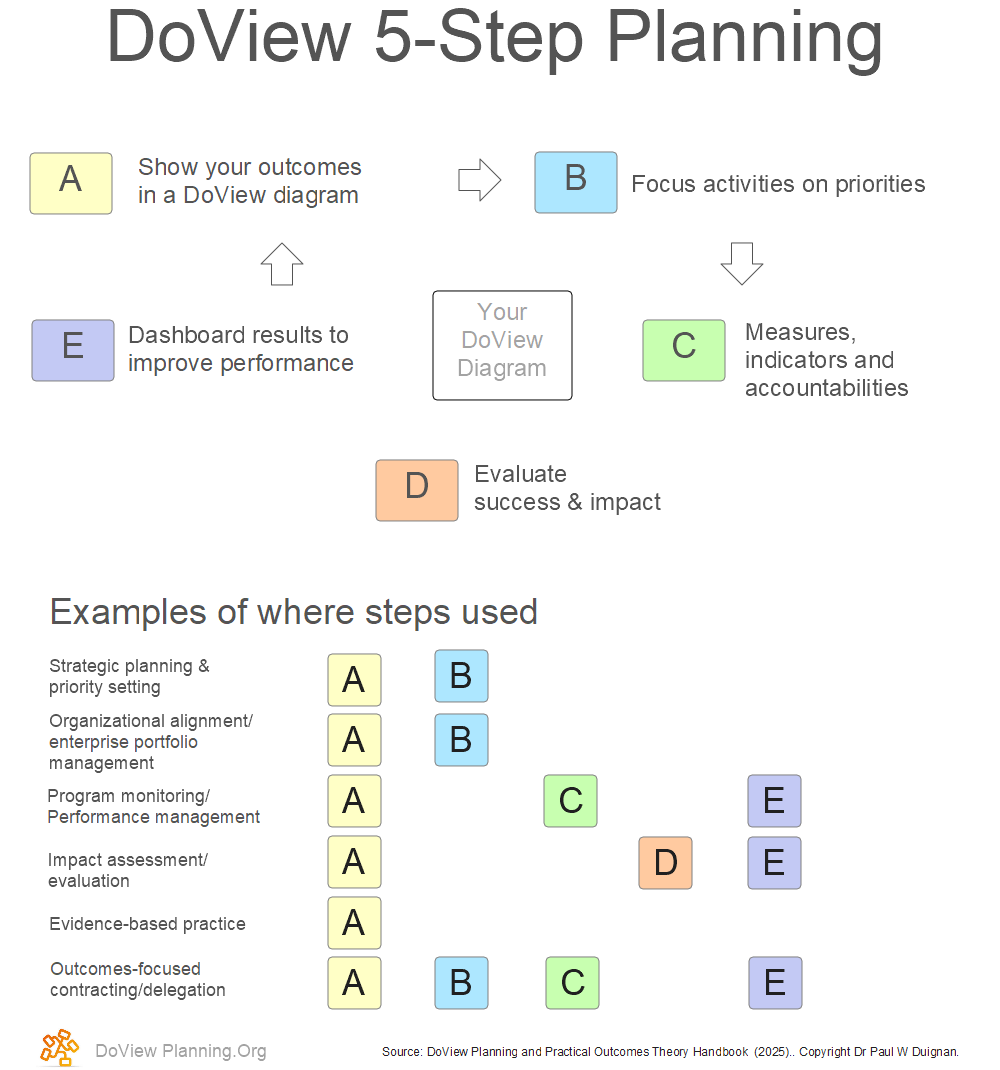
The DoView Planning website fully documents how you can use a DoView Theory of Success in all stages of planning, execution and review. The diagram below shows how it can be used. It shows a typical planning cycle, but the bottom part of the diagram illustrates how the same DoView diagram is used across the whole range of enterprise processes related to planning, execution, performance management, and review. DoView Planning is a methodology which has put the visual Theory of Success right at the heart of planning. This is completely in line with Satya Nadella’s vision for how he wants his Microsoft executives to act.
DoView Planning is evolving and we want to collaborate with others
We know that DoView Planning can definitely work to better achieve enterprise alignment. By now leveraging AI, we have got rid of two previous bottlenecks to its widespread use. The first was having to have skilled consultants to create drafts of DoView Theories of Success; anyone can now do this in minutes for free with the AI DoView Drawing Prompt. Second, it had to be done in the DoView legacy app. This is no longer an issue in that much of DoView Planning can be done in PowerPoint.
We have decided to give our methodology away in the sense that anyone can use it in their work, anyone can consult to others using the methodology and anyone can train others it its use. The only requirement is that its use is fully acknowledged.
We are interested in collaborating with others on the further development of DoView Planning. We believe that DoView Planning provides a tested methodology that can fully operationalize a vision like Satya Nadella’s for how he wants Microsoft executives to act. The good part is that anyone else can now use the methodology for free in whatever setting, large or small, they are working in.
This piece really made me think about the critical importance of a clearly articulated Theory of Success, and I completely agree that its proper operationalization is fundamental for any enterprize. Understanding how to practically align resource allocation to this theoretical framework, as explored with methodologies like DoView, feels like the true challenge and the key to measurable outcomes.